
By Andrew Chan, Co-Founder and Partner. Part 3 of a three-part series.
Executive summary
- Parts 1 and 2 of this series examined how to get customer data. Neither addressed how to prove that personalizing engagement changed customer interaction.
- Personalization makes an individual-level promise, while almost every measurement stack in production evaluates it in aggregate. Selection effects are routinely mistaken for personalization lift.
- In Wave 1 of CVA’s The Scaling Gap™, performance measurement was the workflow most likely to break at today’s volume, and the teams furthest along with AI reported more breakage than the average.
- Only 41% of the 200 senior marketers surveyed in Wave 1 reported being able to measure variant-level performance cleanly.
- Attribution is not proof; it answers the question of which channels perform the best, but not the root cause of what drove the outcomes.
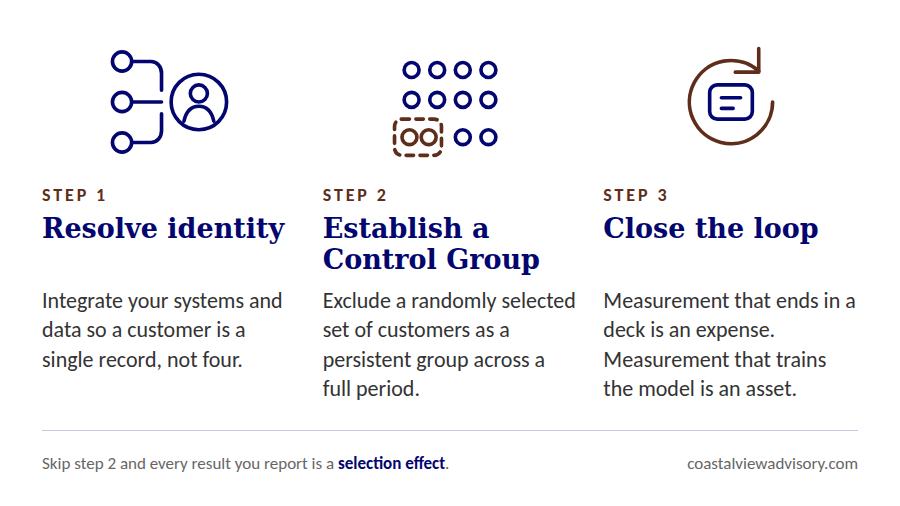
- The measurement layer requires three components: identity resolution, a control group to compare results against, and a feedback loop that returns outcomes to the decisioning model.
- Organizations that cannot answer “what did we get for this” will be defending a large line item with a dashboard that cannot distinguish personalization from selection.
Where we left off
Part 1 of this series described a gap between what consumers now expect from personalized AI and what organizations can actually deliver. The obstacles occur across three areas: a consent architecture built for a simpler world, customer data that is siloed and rarely accessible in real time, and a security exposure that grows with every source. Part 2 focused on how leaders can address the gap, and examined three directions: structured data-sharing partnerships, open API standards with portable and revocable consent, and emerging models that treat personal data as a value exchange rather than a passive extraction.
Both parts were about obtaining and ingesting data. Neither addressed what to do with the data.
Understanding, utilizing, and maximizing customer data has been my focus for most of my career. An organization can solve consent, connect systems, and secure the entire ecosystem, yet still cannot answer the most important question: did any of this change customer engagement? Personalization is sold as a revenue argument, but very few organizations can produce the evidence.
Part 3 focuses on that evidence, and the measurement layer crucial to driving understanding.
Section 4: the proof problem
Personalization is not failing for lack of ambition or investment in tooling. It is failing to produce evidence, and the cause is structural rather than technical.
By the numbers: the proof gap
41% of senior marketers report they can measure variant-level performance cleanly, leaving a majority who cannot. (Coastalview Advisory, The Scaling Gap™ Wave 1, n=200)
35% of senior marketing and finance leaders say more than 20% of their marketing budget is inefficiently allocated. (Haus, 2026 Marketing Decision Confidence Index, n=500)
51% acknowledge they measure what leadership expects, what is highly visible, or what is easy to access, rather than what drives growth. (Haus, 2026)
60% trust independent incrementality testing above every other measurement approach, ahead of media mix modeling at 40% and in-platform reporting at 37%. (Haus, 2026)
4.1 An individual-level promise, evaluated at the campaign level
Personalization makes a commitment to one person at a time, delivering a specific offer, message, and sequence based on what the organization knows about that individual. That is the value proposition, and it is what consumers have come to expect from the platforms setting the standard.
Almost every marketing measurement stack in production today evaluates that commitment in aggregate, through opens, clicks, conversion rate, cost per acquisition, and revenue by campaign. These metrics were designed for an environment where everyone in a segment received the same treatment, and in that environment they were adequate. The KPIs confirm that a campaign performed, but they cannot establish whether personalization was the cause, or whether the same customers would have converted regardless.
The distinction appears academic until considering the investment at stake. A personalized campaign that outperforms an unpersonalized one may be measuring the effect of personalization, or it may be measuring selection. The customers most likely to buy are also the customers with the richest behavioral profiles and therefore the only population the model could personalize for. Both explanations produce identical dashboards, but opposite investment decisions.
4.2 Why the measurement layer breaks first
CVA’s research speaks directly to this point.
In late May, Coastalview Advisory fielded Wave 1 of The Scaling Gap™, a survey of 200 senior marketers at mid-market organizations, asking not whether they had adopted AI but what happened afterward. The most significant finding was that performance measurement was the workflow most likely to break at today’s volume, ahead of review and approvals, project management, and brand consistency. Only 41% of respondents reported being able to measure variant-level performance cleanly.
The second finding is more consequential. Teams furthest along with AI reported more workflows breaking than average teams did, which initially reads as an argument against adoption until the underlying cause is examined. These teams are simply the first to reach the point where the measurement layer gives way, because they generate more variants, more targeting decisions, and more individual-level experiences than a campaign-level reporting stack was built to evaluate.
Personalization accelerates the same effect, because every additional variant subdivides the sample. A stack built to evaluate four creative treatments against a segment is now asked to evaluate thousands of micro-decisions against individuals, and it degrades quietly rather than failing visibly. Reporting continues to render on schedule while its statistical reliability erodes.
Andrew’s lens: In the Army, we had a discipline called battle damage assessment. You did not get credit for the strike. You got credit for the effect, and somebody had to go establish the actual effect. It was slow, unglamorous work, and it was the only thing separating activity from outcome. Most marketing organizations have no equivalent. They report the strike.
4.3 The attribution trap
When organizations do look for proof, they generally turn to attribution, and attribution is not proof.
Attribution divides observed credit among the touchpoints that preceded a conversion. It answers a finance question about which channels perform best, but it does not identify the root cause, which is whether the conversion would have occurred without the touch. For personalization that gap is decisive, because the entire value claim rests on root cause. The claim is not that personalized messages appear in successful customer journeys, it is that personalization changed the outcome.
McKinsey published an example where a European telecom found that customers receiving personalized messages from generative-AI-enhanced campaigns engaged and took action 10% more often than customers who did not receive personalized content. The credibility of that result comes from the control group rather than the size of the lift, because the organization deliberately withheld personalization from a set of customers in order to measure the difference, and accepted the short-term cost.
Withholding personalization from a group of customers is the step that usually does not survive the planning meeting. The objection is reasonable, because a control group looks like forfeited revenue and it is an easy line to cut when the quarter is tight. The cost arrives later, when a decade of personalization spend has to be defended and no one built the instrument to confirm it worked.
Section 5: what the measurement layer requires
This is a solvable engineering and governance problem rather than a frontier research problem. Three components carry most of the requirement.
5.1 Identity resolution, so you know who you actually served
Individual-level measurement requires a resolved individual to measure. The requirement appears obvious, and it is where most programs fail, because the same person arrives as an email address in one system, a device identifier in another, a loyalty number in a third, and an anonymous session in a fourth. Without a durable identity spine, an organization cannot reliably establish who received the personalized experience, and therefore cannot establish what that experience produced.
This is the same integration problem Part 1 described, viewed from the opposite end. Forrester found that only 13% of organizations report having fully integrated, real-time customer data accessible across their systems. That figure is typically cited as a constraint on delivering personalization, and it is an equally material constraint on evaluating personalization.
5.2 Control groups, designed at the individual level and protected
A control group is a randomly selected set of customers deliberately excluded from personalization and held constant while the remaining population receives the treatment. It is the cleanest available way to establish root cause, but it carries a real cost.
The practical requirement is smaller than most organizations expect. A persistent control group of a few percent, maintained across a full measurement period rather than reconstituted per campaign, is generally sufficient to detect effects worth acting on. Protection matters more than size. The control group has to be governed as infrastructure, which means a designated business owner maintains it and has standing authority to decline release requests. These release requests come from campaign and revenue leadership at the end of a soft quarter, and they are made in good faith. An organization that dissolves its control group in November has not saved money, it has produced a year of reporting that cannot be verified.
5.3 A feedback loop that returns the result to the model
Measurement that terminates in a slide deck is an expense, while measurement that returns to the decisioning model is an asset.
The personalization model made a prediction about what a specific person would respond to, and the measurement layer produced evidence about whether that prediction held. Connecting the two, so that outcomes are written back as training signal rather than summarized quarterly for human review, is what converts personalization from a campaign tactic into an operating model that improves. Part 2 raised this point without developing it, and it is the difference between a program that compounds and one that plateaus.
Andrew’s lens: In over a decade of propensity modeling at Deloitte, the model was rarely the hard part. Building a defensible answer to “did this change anything” was the hard part, and it was almost always an organizational problem rather than a statistical one. The teams that got it right were the teams that decided measurement was infrastructure before they needed it, not the teams with the best data scientists.
5.4 What to require of a measurement tool
No tool produces the evidence on its own. The requirements above are organizational before they are technical, and a platform bought ahead of the control group decision will deliver the same aggregate reporting under a different name. Once those decisions are made, tooling becomes a procurement question with a short list of requirements.
Require randomization at the individual level rather than the segment level. Require support for a control group that persists across a full measurement period rather than one reconstituted per campaign. Require results exposed through an API so they can be written back to the decisioning model rather than exported to a deck. Require that the test design and success criteria are fixed before the results arrive. Require confidence intervals rather than point estimates. Require independence from the platform whose spend is being evaluated, because a channel grading its own homework is the condition the measurement layer exists to correct.
Capable open-source options exist for organizations that would rather build than buy. Meta’s GeoLift and Google’s Meridian both support geo-based incrementality testing, and Meta’s Robyn and PyMC-Marketing provide media mix modeling. They require analytical staff to run, and they are explicit about their assumptions, which is more than most in-platform reporting offers.
5.5 Where AI helps, and where it does not
AI is useful at three points in this work, and each one is worth naming separately. The first is test design, where matching comparable control markets and running power analysis are pattern-matching problems that software handles faster and more consistently than an analyst working to a deadline. The second is monitoring, where detecting that a control group has been contaminated by an adjacent campaign is exactly the kind of anomaly nobody is assigned to watch for. The third is the feedback loop itself, where returning outcomes to the model at the cadence personalization operates on is not work a quarterly review cycle can accomplish.
AI is not a substitute for the control group. A model can only learn from what the data contains. If every customer received personalization, nothing in the data shows how customers would have reacted without personalization. A system asked to estimate incremental lift without a control group will return a confident number with nothing behind it. The instrument has to exist before anything, human or machine, can read the result.
Defending the investment
McKinsey puts the typical revenue lift from personalization at 10% to 15%, with company-level results spanning 5% to 25% depending on sector and ability to execute. That range will be cited in budget discussions throughout the coming quarter.
The spread is the more important signal. A range that wide is not a benchmark, it is a description of how differently personalization performs depending on execution, and it says nothing about which end of the range a given organization will reach.
The gap this series has traced runs from what consumers expect, through the infrastructure required to deliver it, and now to the instrumentation required to confirm whether any of it worked. The first two gaps are widely discussed. The third is not, and it will surface first, because the question of what the investment returned arrives on a fixed schedule.
Organizations that build the measurement layer now will be positioned to answer it. Organizations that do not will be defending a significant line item with a dashboard that cannot distinguish personalization from selection.
Wave 2 of CVA’s The Scaling Gap™, fielded with agencies and content companies, closed in early October. It will report on how the organizations producing this work measure what they deliver.
What leaders should do now
For CMOs and brand leaders
- Request proof of impact for your current personalization program rather than the performance report. The response will establish your current position.
- Establish a persistent control group before the next campaign cycle. Designate a business owner who can decline requests to release it, including requests from revenue leadership at quarter end.
- Fund identity resolution as measurement infrastructure rather than as a delivery project, because it serves both purposes and is typically budgeted for only one.
For content companies and agencies
- Bring measurement design into the engagement scope rather than treating it as a downstream client responsibility. Clients are increasingly unable to establish root cause, and increasingly aware of that gap.
- Build fluency in control group design and incrementality, because they are becoming the terms in which content investment is defended.
For every leader
- Treat measurement as infrastructure with a dedicated budget line rather than as reporting.
- Treat any personalization result presented without a control group as a selection effect until demonstrated otherwise.
About the author. Andrew Chan is Co-Founder and Partner at Coastalview Advisory. He began his career as a United States Army Military Intelligence Officer before spending more than 11 years at Deloitte Digital building practices in data science, customer segmentation, marketing technology architecture, and generative AI platforms, with advisory experience across the technology, media, and telecommunications industries.
If you are working out how to prove what your personalization investment is delivering, this is exactly the work CVA was built for. We help organizations assess where they stand, identify what needs to change, and build the operating models, data architecture, and governance to make generative AI investments deliver real results at scale. Start a conversation.